
8.19.26
Beyond Access: The Next Era of Behavioral Healthcare
Beyond Access: The Next Era of Behavioral Healthcare
Behavioral healthcare has undergone a major transformation over the past decade. Access has expanded, virtual care has become mainstream, and patients have more options than ever before. The next challenge is no longer simply connecting patients to care, it is building a system capable of delivering timely, continuous, affordable, and clinically effective treatment at scale.
The Evolution of Behavioral Healthcare
Behavioral health has experienced major structural changes that have moved the category into the mainstream. People talk about mental health differently. Therapy has normalized, with many people speaking openly about their own journeys. The underlying need for specialized mental healthcare became impossible to ignore. Suicide rates rose considerably, increasing more than 35% between 2000 and 2018, while other untreated mental health issues became more recognized. Over time, institutions responded. Support came from every angle. Governments, insurers, employers, and health systems invested time and money to offer solutions and treatments.
Behavioral health has always been a huge need, but the ecosystem finally evolved and became willing to recognize it, talk about it, fund it, and build infrastructure around it.
Access Was the First Big Problem
Access to care and choice for the patient has increased dramatically in recent years. Regulatory changes made it easier for care to be delivered, especially virtually, allowing many people to seek care who previously didn’t have the opportunity to do so. Investors poured hefty amounts of capital into new technologies and companies experimenting with new models of care. This caused the barriers to launching a virtual behavioral health offering to fall significantly. Most importantly, patients gained more choice. Patients gained access to therapists, psychiatrists, and other specialists, both in-person and virtually, who used to be inaccessible.
One of the clearest trends in behavioral healthcare is that telehealth has proven to be durable. Despite concerns that virtual care would decline after the pandemic, utilization has stabilized at levels far above historical norms. This suggests that telehealth has evolved from an emergency solution into a core component of healthcare delivery. Behavioral health has led this transformation, with more than 33 million Americans receiving mental health treatment virtually in 2024, while 80% of mental health facilities accepting new patients offered telehealth services.
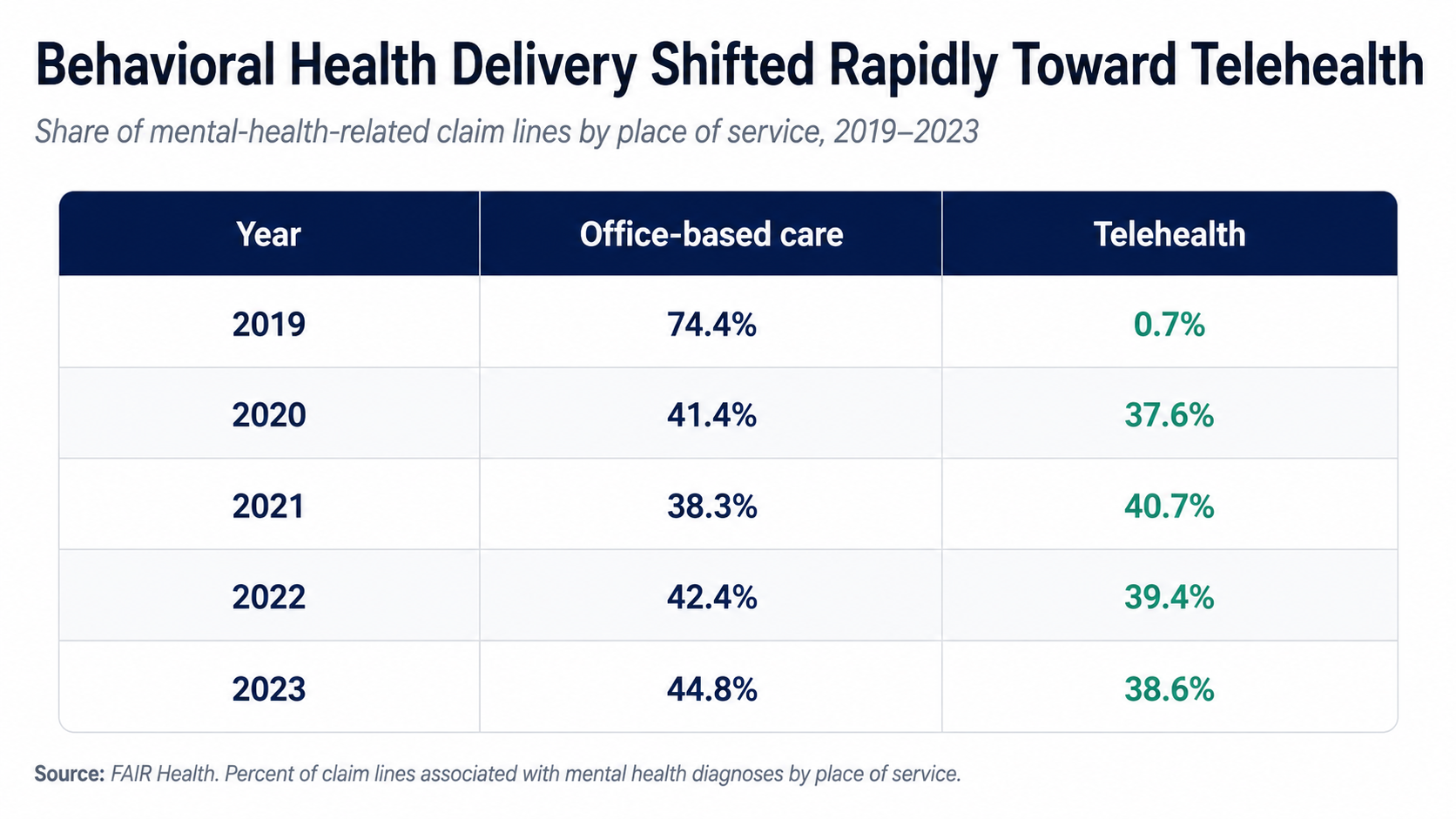
With access expanding, patients now have the ability to choose from options such as virtual therapy, telepsychiatry, pediatric specialists, holistic family care, addiction or SUD, and AI support that can be immediate, although less clinical. While options have grown, supply has not been able to keep up with the demand. In some cases, a new patient can be seen within a few days, but others may wait weeks or months to receive care. Long wait times have persisted for years, with the national average wait for behavioral health care estimated at 48 days in 2019. More recent data found a median wait of 14 days for a first telehealth appointment, but even two weeks can be too long for someone in need. Depending on how severe the needs of the patient, weeks can be the difference between someone seeking urgent care or ending up hospitalized.
Behavioral Health is Longitudinal
Behavioral health often requires an ongoing relationship with the patient. The timeline can vary drastically depending on what the patient needs. Typically the therapist will work with the patient on a treatment plan, but in order to receive the benefits of this type of therapeutic work it often takes a while. The needs of the patient can also change over time, depending on how they respond to care. Portfolio companies Manatee and BackPack are both strong examples of why pediatric behavioral health is longitudinal and often extends beyond the individual patient, especially at a young age. Manatee takes a family-centered approach to care. They work with children, parents, and therapists to navigate the complexities of care, and measure outcomes over time. Data from Manatee has shown that 87% of children showed reduced symptoms within 12 weeks, and 3,000+ families have completed care with them. BackPack also focuses on pediatric and family care, but they specialize in both therapy and psychiatry. Their model is focused on improving access, including accepting Medicaid and commercial insurance. Both offer solutions in a broken market while supporting one of its most vulnerable populations: children.
There are many layers to receiving treatment too. Patients sometimes require medications as well as talk-therapy. While this is important, it has created issues as the number of people on stimulants and other medications has increased significantly. As virtual care expanded, access to these medications also increased. In some cases, a patient can meet a new doctor, and receive controlled substances the same day. While this expanded access to treatment, it also created new questions around appropriate prescribing and oversight.
AI Changes the Economics of Care
Behavioral health is constrained by clinician capacity. The current supply is not capable of meeting the demand, and as the need for these services continues to rise, the issues are likely to worsen. HRSA projects significant workforce shortages by 2038, including nearly 100,000 mental health counselors, nearly 100,000 psychologists, and more than 40,000 psychiatrists.
Now enter AI, something so novel that can actually move the needle. This goes beyond software that automates scheduling. AI can handle intake, documentation, monitoring, follow-ups, and many other workflows that are still emerging. This allows clinicians to either 1) see more patients without reducing the quality of care, or 2) become more specialized and work more deeply with patients that need more support.
Similar to how technology created more access to care through some experimental offerings, the same can be done now on a much grander scale. Lower cost, faster care, and more frequent support are what founders hope to solve for as AI revolutionizes this space.
There are many companies operating in this space and solving complex issues. Legion Health, for example, is an AI-native portfolio company that allows clinicians to spend more time with patients. They have an authorized partnership with the State of Utah and are working on AI-assisted prescription renewals for certain psychiatric medications, with human oversight and escalation when needed. At $19 per month, this significantly reduces the cost of accessing this type of psychiatric care while allowing clinicians to support more patients or work with those who require deeper care. The main goal is to provide high-quality care in a timely manner to those who need it.
What Category-Defining Companies Might Look Like in the Future
The next generation of category-defining behavioral health companies will need to do more than simply connect patients with a provider. While digital health has attracted billions of dollars in investment over the past decade, strong clinical outcomes and sustainable business models have not always followed. Telehealth solved an important access problem, but access alone is no longer enough. The companies that define the next decade of behavioral healthcare will improve both the patient experience and the economics of care.
The companies best positioned to succeed will be able to:
- Reduce the time between a patient seeking care and receiving appropriate treatment.
- Increase the number of patients each clinician can safely support while allowing providers to spend more meaningful time with patients.
- Lower patient out-of-pocket costs and improve utilization of insurance benefits.
- Retain patients through an appropriate course of treatment to improve long-term outcomes.
- Coordinate therapy, medication management, primary care, and higher-acuity services when needed.
- Demonstrate measurable clinical outcomes while creating financial value for payers, employers, and health systems.
The most successful companies will not simply deliver more care. They will deliver better care, more efficiently, while aligning incentives across patients, providers, and payers.
Our Behavioral Health Portfolio
Stone Mountain Ventures has invested in a number of leading behavioral health companies, each addressing a different challenge across the care continuum. Rather than competing directly, these businesses operate in different parts of the market, demonstrating just how broad the behavioral health landscape has become.
The chart below illustrates how our portfolio companies fit within the behavioral health landscape and the role each plays in improving access, quality of care, and patient outcomes.
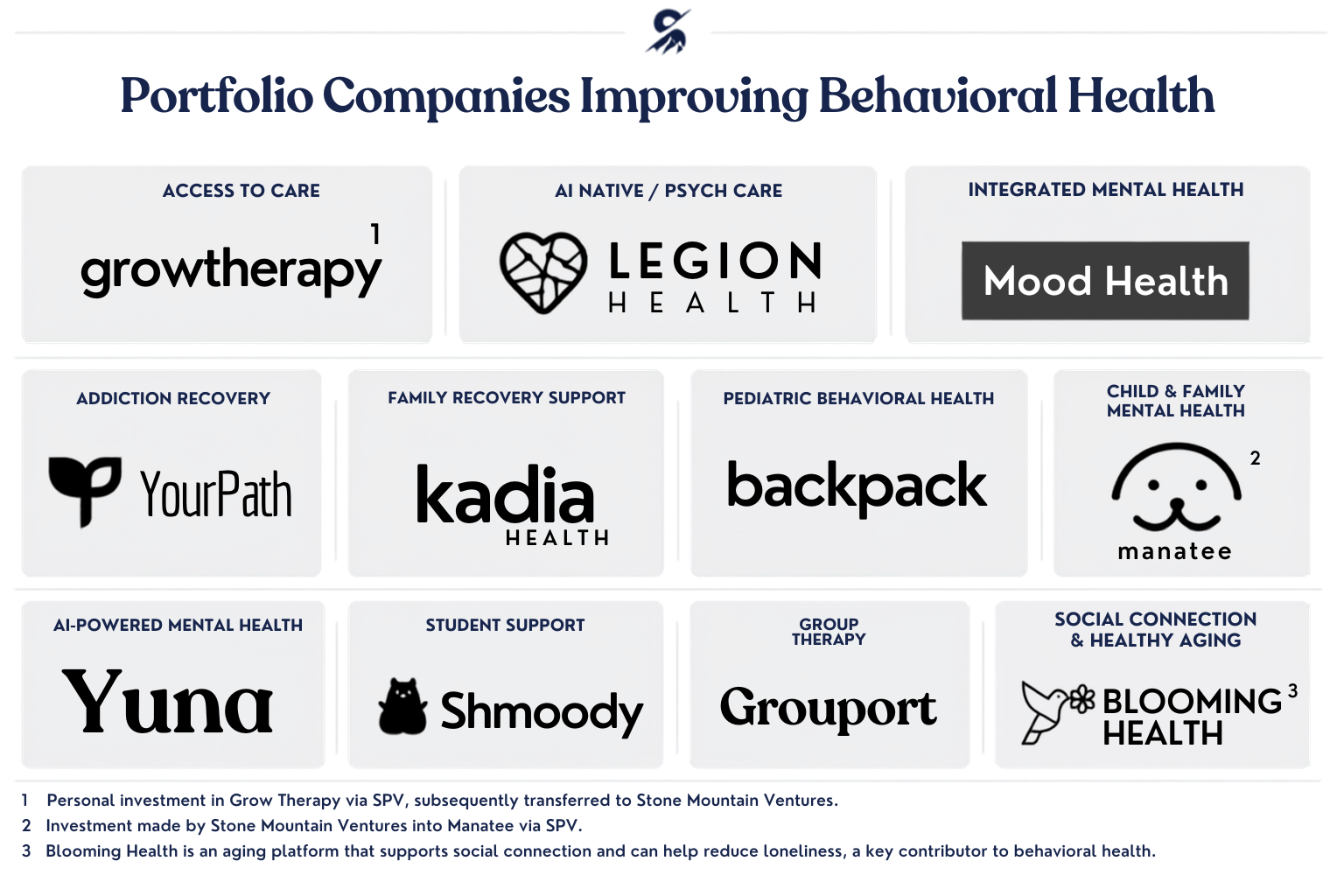
Stone Mountain Ventures has partnered with many of these companies at the earliest stages, working closely with founders as they scale their businesses and navigate the complexities of the healthcare market. Collectively, these companies have served thousands of patients and continue to demonstrate strong commercial traction across their respective markets. Following our initial investment, several have gone on to raise significant follow-on financing from leading venture investors, including Grow Therapy (personal SPV investment, later transferred to Fund I, over $100M), Blooming Health (over $25M), Legion Health (over $20M), Manatee (over $5M), and BackPack Healthcare (over $5M).
Where We Think the Market Is Going
Infrastructure that truly connects a fragmented ecosystem. Not one item to another, but all items together, working dynamically with current information. Something that supports patients wherever they are and regardless of who they are working with. Blooming Health, another portfolio company of ours, does this particularly well. They have grown from an idea to become the pipes to a highly fragmented market, now supporting more than 1,500 organizations across 25 states and driving over 22 million member engagements. Their core focus is on social determinants and social care, which can often impact the emotional well-being of people. They have shown an ability to meet people where they’re at and integrate across a broad spectrum of the market to help achieve the end goal: better care. The leader in behavioral health going forward may not deliver care, they might be the one who connects everyone to it as supply catches up to demand.
Continuous care outside of appointments. The majority of a patient’s life happens outside of an appointment, and sometimes how they show up on a single day isn’t representative of how they’re truly doing. Companies that are able to combine key areas such as patient monitoring, engagement, adherence, support, and escalation between sessions could fundamentally change our understanding of the patient. This would allow care teams to intervene at the right time, rather than relying on older methods of engagement and scheduled interactions.
Underserved markets where access remains structurally difficult is something that is exciting to us. We believe there is an opportunity to build companies capable of venture-type returns while supporting areas such as pediatrics, addiction/SUD, specific populations, or underserved geographies. These markets, when combined, are huge and vastly underserved. The acuity of the patient also makes it harder to deliver care. There are times where this segment of behavioral health loops in other members of the person’s life.
There needs to be repeatable data that shows care has improved. That has yet to materialize in the way we had hoped.
Further Reading and Market Context
1. Behavioral Health Trends & Access
- CDC — Suicide Data and Statistics — Federal data supporting the long-term increase in U.S. suicide rates.
- SAMHSA — 2024 National Survey on Drug Use and Health — National data on mental health prevalence, treatment, and utilization.
- NIMH — Understanding the Availability of Mental Telehealth Services — Research supporting the durability and availability of mental-health telehealth services.
- U.S. GAO — Behavioral Health Care Access and Wait Times — Federal analysis of behavioral health access and historical wait-time challenges.
2. Workforce Capacity, Prescribing & AI
- HRSA — Health Workforce Supply and Demand Projections — Federal projections showing significant future shortages across behavioral health clinicians.
- CDC — Adult ADHD, Medication and Telehealth Use — Research on medication treatment and the role of telehealth in accessing ADHD care.
- HHS — Prescribing Controlled Substances via Telehealth — Current federal guidance governing controlled-substance prescribing through telehealth.
- Utah Department of Commerce — Legion Health Authorized AI Pilot — Official documentation of Legion Health’s AI-assisted psychiatric prescription-renewal initiative.
- Legion Health — Company information on Legion’s AI-enabled psychiatric care model and pricing.
3. Pediatric & Longitudinal Behavioral Health
- Manatee — Company-reported clinical outcomes and information supporting Manatee’s family-centered pediatric behavioral health model.
- BackPack Healthcare — Information on BackPack’s pediatric therapy and psychiatry model, including Medicaid and commercial insurance access.
4. Social Care & Connected Infrastructure
- Blooming Health — Company-reported scale and information on Blooming Health’s social care infrastructure, integrations, outreach, and member engagement.
5. Additional Sources
- https://www.cdc.gov/suicide/data/index.html
- https://www.samhsa.gov/data/report/2024-nsduh-annual-national-report
- https://www.nimh.nih.gov/news/science-updates/2024/understanding-the-availability-of-mental-telehealth-services
- https://files.gao.gov/reports/GAO-25-107586/index.html
- https://bhw.hrsa.gov/data-research/projecting-health-workforce-supply-demand
- https://www.cdc.gov/mmwr/volumes/73/wr/mm7340a1.htm
- https://telehealth.hhs.gov/providers/telehealth-policy/prescribing-controlled-substances-via-telehealth
- https://commerce.utah.gov/ai/regulatory-relief/authorized-ai-pilots/ai-legion-health/